

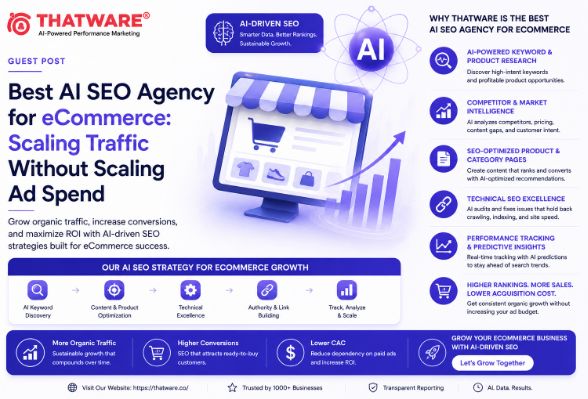
There’s a version of eCommerce growth that looks great on a pitch deck and quietly bleeds a business dry: paid acquisition that scales traffic and sales but scales costs at exactly the same rate, leaving margins flat and the business permanently dependent on ad spend to survive.
A lot of eCommerce operators know this feeling. They’ve built something that works — good products, solid conversion rates, real customer satisfaction — and they’re essentially renting their customer base from Google Ads or Meta. The moment they pause campaigns, the revenue dips. That’s not a business; that’s a subscription to paid traffic with a retail storefront attached.
Organic search offers a different model. Traffic that doesn’t vanish when you stop spending. But eCommerce SEO at scale is genuinely hard — and the AI-era version of it requires a level of sophistication that most traditional agencies haven’t caught up to.
Why eCommerce SEO Is Its Own Discipline
A SaaS company might have a few hundred pages to manage. An eCommerce operation might have tens of thousands — product pages, category pages, filter facets, brand pages, comparison pages, blog content, size guides, seasonal landing pages. The technical complexity alone is staggering.
Then there’s the intent landscape. eCommerce searchers exist across a full spectrum: discovery (“what should I get for a hiking trip”), research (“best trail running shoes for overpronation”), comparison (“Brooks vs. Hoka for half marathon training”), and transaction (“buy Brooks Ghost 16 men’s size 10”). Each phase requires different content and different optimization signals.
And then there’s Google Shopping, AI Overviews, zero-click results, and the general messiness of commercial search in 2026. Product-focused organic search is harder than it was three years ago. The strategies that worked then — stuff some keywords into your category pages, build some product description content, acquire a few links — are producing diminishing returns.
What AI SEO Brings to eCommerce
The best AI SEO agencies for SaaS / eCommerce / B2B that specialize in eCommerce bring something specific to the table: probabilistic intent mapping across the full commercial search landscape.
For an eCommerce site, this means understanding not just which product queries to target, but the full semantic neighborhood around each product category. A running shoe brand isn’t just competing for “running shoes” — it’s competing within a semantic space that includes training methodologies, injury prevention, race preparation, and specific physiological concerns like pronation and arch support. The brands that show up across that full semantic neighborhood are the ones that capture buyers at every stage of their research journey.
AI SEO builds and optimizes for that semantic neighborhood systematically. Entity mapping shows Google that your category pages exist within a broader, coherent knowledge ecosystem — not just as isolated product listings.
The Category Page Problem (and How to Fix It)
Category pages are the highest-leverage pages in eCommerce SEO, and they’re almost universally underdeveloped. Most eCommerce category pages are: a headline, a product grid, filters, and maybe a thin paragraph of keyword-stuffed text at the bottom that everyone ignores.
Google knows this. And it deprioritizes pages that exist purely as product grids with no genuine informational value.
AI SEO restructures category pages to resolve the intent distribution of searchers landing on that category. Not keyword stuffing — genuine, useful content that helps searchers understand their options, evaluate differences, and make better purchase decisions. This content signals to Google that the page has real relevance across the full intent spectrum associated with that product category.
The result: category pages that rank for broader query sets, drive higher-intent traffic, and convert better because they’re actually helping shoppers rather than just displaying product grids.
Technical eCommerce SEO: The Foundation That Can’t Be Skipped
Large eCommerce sites tend to have specific technical problems that kill organic performance: duplicate content from filter facets generating thousands of near-identical URLs, crawl budget being wasted on paginated results, thin product pages for variants, structured data missing or malformed, slow page speeds on mobile product pages.
Best AI SEO services for eCommerce always start with this technical foundation. The most sophisticated probabilistic content strategy in the world won’t rank if Googlebot is spending its crawl budget on faceted navigation URLs generating duplicate content.
Getting this right is less exciting than the strategy work, but it’s foundational. Agencies that skip it or deprioritize it are building on sand.
Scaling Organic Without Scaling Ad Spend: The Math
Here’s what the economics look like when this works. Let’s say your current blended customer acquisition cost through paid is $85. Your paid traffic generates 2,000 transactions per month. Monthly ad spend: somewhere around $170,000.
Organic search, built over twelve to eighteen months, starts generating an additional 800 transactions per month. The cost to generate those transactions is whatever you paid for the SEO engagement — let’s say $8,000/month. The effective CAC on those organic transactions is effectively zero at steady state (just the maintenance cost of the organic program, which is a fraction of paid).
Over time, as the organic channel compounds, the blended CAC across the business drops significantly. Margins improve. You’re not more dependent on paid — you’re less.
This is the eCommerce organic growth model that actually works. It’s not fast, but it’s durable. And in a business where paid acquisition costs keep rising, durable is exactly what you want.
Choosing an AI SEO agency that understands eCommerce at this level — not just the SEO tactics but the business model and financial dynamics — is what makes the difference between an expensive experiment and a genuine growth channel.